Open API integration means your own code calls a publicly available interface, usually with an API key or token, so your application can read or send data without a person in the loop. It holds up in production when you pin the API version, keep credentials in a secret manager, respect rate limits, and retry carefully with idempotency keys. The word open describes who may call the service, while the OpenAPI Specification is a separate format for describing it.
- An open API is a publicly available interface that outside developers can call, while a private API stays inside one company or a small partner group.
- The OpenAPI Specification is a vendor-neutral description format for HTTP APIs, so a private API can use it just as well as a public one.
- A production integration needs a pinned version, a timeout, a retry limit with backoff, and an idempotency key on any call that creates or changes data.
- Logging the provider request ID beside your own trace ID lets you follow one failed job from end to end.
- Confirm the current specification version and rate limits in the provider's own documentation before you design around them.
What Open API Integration Means in Practice
Open API integration means your own code calls a public service over the internet instead of moving data by hand. An open API, often called a public API, is open to outside developers, though the provider may still ask you to register and follow quotas. A private API stays inside one company or a small group of partners.
One naming trap causes most of the confusion. An open API is a type of access, while the OpenAPI Specification is a written format for describing HTTP APIs. You can describe a private API with that specification, and you can also publish an open API with plain hand-written docs.
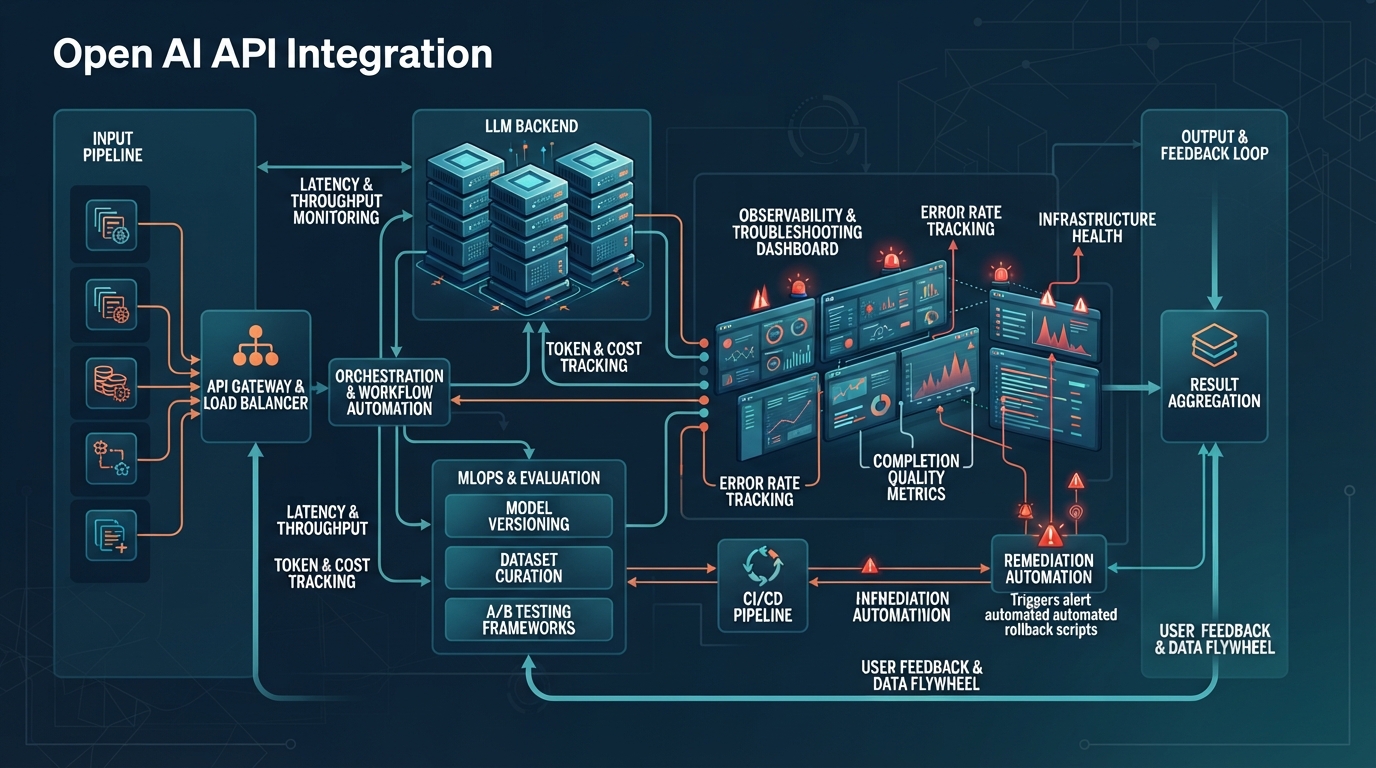
In an AI pipeline, this layer sends prompts, fetches embeddings, or writes results into another system. It is also the layer that fails at 3 a. m.
Treat the Interface as a Contract, Not a Script
A public interface is a promise from a team you cannot see. They control versions, limits, and uptime, so test and watch the integration like a contract.
- Authentication: an API key or OAuth token proves who is calling, so store it in a secret manager instead of code.
- Rate limits: the provider caps how many calls you send, so read the response headers instead of guessing.
- Versioning: old versions retire on the provider's schedule, so pin the version you call.
- Idempotency: a unique key on a create call stops a retry from duplicating the action.
What to Check Before You Ship
- Confirm the token lifetime and build a refresh path instead of hard-coding a long-lived key.
- Learn which status codes mean retry and which mean stop.
- Set a timeout on every call, then add a retry limit with growing delays and random jitter.
- Log the provider request ID next to your own trace ID so support can follow one failed job.
A Safe First Call and the Result to Expect
Start with one read-only endpoint. A read cannot damage data, and it checks four things at once: network and TLS, the auth header, the request shape, and the response shape.
A healthy call returns HTTP 200 with JSON that matches the documented schema. A 401 or 403 usually means a missing or expired credential. A 429 means you are calling too fast. A 5xx means the provider is struggling, so back off and retry later.
When Calls Fail in Production
- Retry only safe calls: reads, or writes that carry an idempotency key.
- Move the failing call out of the critical path and let a background worker finish the job later.
- Save the raw request and response so you can replay the job after the provider recovers.
Where to Confirm the Current Details
Versions and limits change, so check them at the source before you design around them. The OpenAPI Initiative released version 3. 1.
0 in February 2021, and its April 2025 newsletter said the 3. 2 line was still coming together.
OpenAPI Specification (official specification page)
Sources
- Open API Wikipedia · 2026-09-29
- OpenAPI Specification 3.1.0 Released OpenAPI Initiative · 2021-02-18 · 2026-09-29
- OpenAPI Initiative Newsletter – April 2025 OpenAPI Initiative · 2025-05-02 · 2026-09-29
- OpenAPI Specification v3.1.1 OpenAPI Initiative · 2026-09-29